The 10% Rule: Why Consumers in 2026 are Voting with their Wallets
Sustainability is no longer a niche boutique movement; it’s a mainstream expectation
FACTS AND DATA
GW Authors
4/2/20263 min read
The Stat That Defines the Year
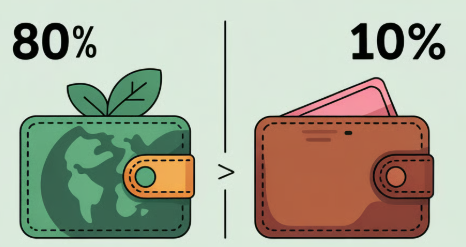
According to recent 2026 consumer reports, the "Intention-Action Gap" is finally closing, but it’s hitting a financial ceiling. While 80% of global consumers say they prioritize eco-friendly goods, their willingness to pay extra is highly calculated.
The magic number? 9.7%.
On average, shoppers are willing to pay roughly 10% more for products that are sustainably produced or sourced. Once a price tag climbs 15% or 20% above the "conventional" version, interest doesn't just dip, it craters. In 2026, sustainability is a tie-breaker, and it's important to be aware that financial limitations do play a significant factor in consumer behaviour.
What’s Driving the "10% Limit"?
Inflation Fatigue: After years of volatile grocery and energy prices, the global consumer is "tapped out." They want to do the right thing, but they are auditing every dollar.
Sustainability as "Table Stakes": In 2026, consumers believe planet-friendly practices should be the standard, not a premium add-on. There is a growing resentment toward "Green Premium" pricing, with 64% of shoppers viewing excessive eco-pricing as a form of corporate greed.
The Rise of Private Labels: "Store brands" have caught up. You can now find organic, plastic-free, or carbon-neutral options on the bottom shelf for the same price as the big-name legacy brands.
What are we actually wearing?
If you check the "Digital Product Passport" (now standard on most EU and North American garments) of a typical shirt sold in 2026, the material list has evolved.
The Death of "Virgin" Polyester: Plain petroleum-based polyester is becoming a social faux pas. In its place, Recycled Polyester (rPET) and Textile-to-Textile recycled fibers have seen a 76% increase in market share since 2024.
The Mycelium Moment: We’ve officially moved past the "experimental" phase of bio-materials. Lab-grown Mushroom (Mycelium) Leather and Algae-based dyes are appearing in mid-market retail, not just high-fashion runways.
The Lyocell Surge: Because of its closed-loop production, Lyocell has outpaced traditional silk and rayon, growing 42% in usage this year alone.
The "Alienation" Factor
While consumers are price-sensitive, they are also highly punitive. 2026 data shows that 84% of customers will actively walk away from a brand if they discover a "compliance scandal" or "greenwashing."
It’s a paradox: Shoppers might not pay 20% more to help you, but they will definitely leave you if you hurt the planet.
The Bottom Line for 2026
Sustainability in 2026 is about efficiency, not ego. The brands winning this year aren't the ones asking for the biggest premium; they are the ones who have figured out how to make "green" cost the same as "grey."
If you can keep your eco-innovation within that 10% window, the market is yours. Go over it, and you're just a luxury item in a world that’s looking for a solution.
The 2026 Cheat Sheet: Top 5 Fabrics to Look For
Navigating a clothing store (or a resale app) can be overwhelming. If you want to stay within the 10% Rule while still being an eco-warrior, keep an eye out for these five materials:
Lyocell (TENCEL™): * Why it’s winning: Made from wood pulp in a "closed-loop" process, meaning 99% of the water and solvents are recycled. It’s softer than silk and much tougher.
Mycelium (Mushroom) Leather: * Why it’s winning: It offers the durability of animal hide without the high carbon footprint. Look for it in high-wear items like wallets, belts, and sneakers.
Recycled Cotton (rCotton): * Why it’s winning: Traditional cotton is a water hog. rCotton takes post-consumer scraps and spins them into new yarn, saving thousands of gallons of water per shirt.
Algae-Based Polyester: * Why it’s winning: We’re finally moving away from oil. Algae sequester carbon as they grow, and the resulting fibers are naturally biodegradable, unlike traditional synthetics.
Hemp Blend: * Why it’s winning: Hemp is a "super-crop" that needs zero pesticides. In 2026, we’ve perfected the softening process, so it no longer feels like wearing a burlap sack it’s as comfy as your favorite vintage tee.
For years, the "Green Premium" was treated like a luxury tax. If you wanted to save the ocean, you had to pay double for the sneaker. But as we move through 2026, a new economic reality has set in. Sustainability is no longer a niche boutique movement; it’s a mainstream expectation, but it has a very specific price tag.
Welcome to the era of the 10% Rule.
Contacts
greenlyworld@hotmail.com