
A complete guide to stainless steel
Learn everything about stainless steel for your home
GUIDES AND TIPS
GW Authors, Jon
6/2/202610 min read
A Complete Guide to Stainless Steel
There's a material sitting in most of our kitchens right now that doesn't get nearly enough credit. It's not glamorous. It doesn't have a clever brand story or a sleek social media presence. It's just there, on the hob, in the cupboard, in the packed lunch box, quietly doing its job without complaint and without adding anything harmful to your food or the planet.
I'm talking about stainless steel, and I think it deserves a proper moment in the spotlight.
This guide covers everything: the history (which is genuinely fascinating), the health science, the sustainability story, and practical buying advice so you can cut through the noise next time you're standing in a kitchen shop wondering what the numbers on the bottom of a pan actually mean.
Table of Contents
A Brief History of Stainless Steel
The story of stainless steel starts, as many good stories do, with a happy accident.
It was 1913, in Sheffield, England, then the steel capital of the world. A metallurgist named Harry Brearley was tasked with a very unglamorous problem: finding an alloy that would resist the wear and erosion inside gun barrels. Not the most eco-friendly origin story, I'll admit.
Brearley was experimenting with various steel-chromium blends and discarding those that didn't meet his brief. Months later, he noticed something strange while clearing out his experimental scraps: one particular batch, containing around 13% chromium, had refused to rust. Everything else in the pile had corroded and stained. This piece was pristine.
He tested it with acids. It held. He left it out in the weather. Still nothing.
The discovery that chromium, when added in sufficient quantities to iron, creates a self-repairing invisible protective layer on the surface of the metal was not what Brearley had been looking for. But it turned out to be one of the most useful materials accidents in modern history.
By the 1920s, "rustless steel" (as it was first marketed) had found its way into cutlery, surgical instruments, and chemical plants. By the 1930s, architects were clad entire buildings in it, most famously the gleaming eagle gargoyles and the spire of the Chrysler Building in New York, which still catch the light exactly as they did nearly a century ago.
The stainless steel we now use in cookware, water bottles, and food containers is a direct descendant of Brearley's discarded experiment. Not bad for something that was nearly thrown away.
What Actually Is Stainless Steel?
Stainless steel is an alloy, a mixture of metals, rather than a single material. At its core it's iron, but what makes it "stainless" is the addition of at least 10.5% chromium.
The chromium reacts with oxygen in the air to form a microscopic, transparent oxide layer on the surface. This layer is self-healing: if you scratch stainless steel, it repairs itself on exposure to air. It's this passive layer that prevents rust and corrosion, and it's why stainless steel behaves so differently from ordinary steel, which will rust if you look at it sideways.
Different grades of stainless steel are produced by tweaking the recipe, adding more or less nickel, molybdenum, manganese, or other elements. This changes the properties of the finished metal.
Decoding the Numbers
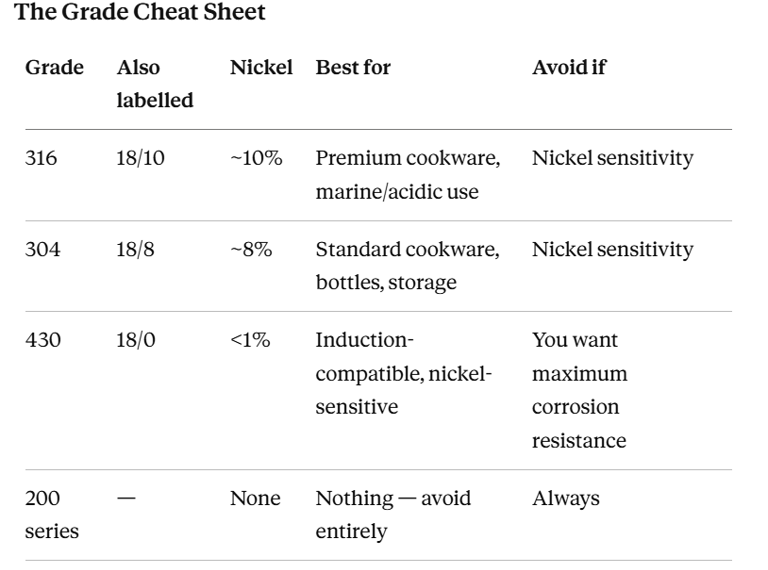
When you see cookware labelled 18/10 or 18/8, those two numbers are telling you the percentage of chromium and nickel in the alloy.
18/10 (Grade 316): 18% chromium, 10% nickel, plus a small addition of molybdenum. This is sometimes called "surgical" or "marine" grade. The molybdenum gives it extra resistance to saltwater and acids. The best choice for food contact.
18/8 (Grade 304): 18% chromium, 8% nickel. This is the industry standard for quality cookware and food storage. Excellent corrosion resistance and completely suitable for daily kitchen use.
18/0 (Grade 430): 18% chromium, essentially no nickel. Less corrosion-resistant, but the right choice for anyone with a nickel sensitivity. Also magnetic, which means it works on induction hobs.
200 Series: The one to avoid. This cheaper grade substitutes manganese for nickel to cut costs. It corrodes more easily, which means more metal can leach into food over time. Cheap imported cookware sometimes uses this without disclosing it, which is a genuine consumer issue.
If a product doesn't tell you its grade, treat that as a red flag.
How Quality Cookware Is Actually Built
A detail that surprises a lot of people: quality stainless steel pans aren't solid stainless steel all the way through. Because stainless steel is actually a poor conductor of heat on its own, most good cookware uses tri-ply or clad construction, layers of stainless steel on the inside and outside, with an aluminium core sandwiched between them.
The aluminium handles heat distribution; the stainless steel provides the non-reactive cooking surface. The aluminium never touches your food unless the pan is significantly damaged. This is a feature, not a compromise.
Is Stainless Steel Safe?
For the overwhelming majority of people, stainless steel is one of the safest materials you can cook and store food in. It contains no PFAS, no BPA, no phthalates, and no chemical coatings that break down over time.
But it's worth understanding the full picture rather than just taking the marketing at face value.
Yes, Small Amounts of Metal Can Leach
This is documented in peer-reviewed research and worth being honest about. A study published in the Journal of Agricultural and Food Chemistry (Kamerud et al., 2013) tested multiple grades of stainless steel cooking tomato sauce for extended periods. After six hours, nickel concentrations had increased up to 26-fold and chromium up to 7-fold in the sauce, depending on the grade of steel used.
Before that sends you running to throw out your cookware, here's the crucial context:
The leaching was highest with brand-new pans and dropped significantly after the sixth use cycle, as the protective oxide layer became more established.
Even at elevated levels, the concentrations remained within ranges considered safe by regulatory agencies for the general population.
The conditions tested (six hours of acidic tomato sauce) are a worst-case scenario, not a typical dinner.
The main variables that increase leaching are: acidic food, high heat, long cooking times, newer pans, and lower-quality steel grades. Flip those around, non-acidic food, shorter cooking, seasoned pans, 304 or 316 grade and leaching is negligible.
The Nickel Conversation
Nickel sensitivity is more common than most people realise. Research in Contact Dermatitis (Ahlström et al., 2019) estimates that nickel allergy affects 8–19% of adults, with women affected at roughly three to ten times the rate of men, largely due to historical exposure through jewellery and piercings.
For people who are nickel-sensitised, oral exposure to nickel, including from cookware can trigger dermatitis flare-ups. If this is you, the practical solutions are clear: choose Grade 430 (18/0) stainless steel with minimal nickel content, or switch to cast iron, carbon steel, or ceramic cookware for your daily cooking. These are all excellent materials in their own right.
For everyone else, the nickel from stainless steel cookware is well below the tolerable daily intake threshold, and worth noting that foods like chocolate, nuts, oats, and legumes naturally contain far more nickel than your pan contributes.
What About Chromium?
Chromium comes in two forms that behave completely differently in the body. The form that leaches from cookware is chromium III, which is also found naturally in food and is considered low in toxicity at normal levels. The dangerous form chromium VI is a known carcinogen, but it's produced by industrial processes like welding and chrome plating, not by cooking in a stainless pan. Normal cooking temperatures don't convert one to the other.
The Short Answer
Stainless steel is safe. Use it confidently, especially for 304 or 316 grade cookware. Break in new pans before using them for long acidic cooks. If you're nickel-sensitive, go for 18/0 or switch to cast iron. That's really all there is to it.
Is Stainless Steel Sustainable?
Here's where stainless steel gets genuinely interesting, and where the full lifecycle picture matters more than the headline.
The Production Problem
Let's not sugarcoat this. Mining the raw materials for stainless steel, iron ore, chromium, and nickel, is environmentally disruptive. It causes deforestation, soil erosion, and water contamination in mining regions. Chromium mining is concentrated in South Africa, Kazakhstan, and Turkey; nickel comes primarily from Indonesia, the Philippines, and Russia.
After mining, the production process involves smelting in electric arc furnaces at temperatures above 1,500°C. This is energy-intensive at a scale that adds up: global stainless steel production exceeds 58 million tonnes annually, and the aggregate carbon footprint is substantial.
Production of stainless steel is not eco-friendly. Full stop.
The Durability Argument
But here's the other side of the ledger, and it's compelling.
Stainless steel is 100% recyclable without any loss of quality, indefinitely. A stainless pan recycled today can be melted down and turned into a stainless pan of identical quality. And crucially, this actually happens: according to the International Stainless Steel Forum, approximately 95% of stainless steel is recovered and recycled at end of life. New stainless steel production already incorporates roughly 60% recycled content on average, because steel scrap has high economic value.
Compare that to PFAS-coated nonstick pans, which cannot be recycled, leach forever chemicals into waterways as they degrade, and typically need replacing every 2–5 years. Or to plastic containers, which can be recycled only a handful of times before the material degrades and ends up in landfill.
A good stainless steel pan lasts 20–30 years with basic care. Over that same period, you'd get through six to fifteen nonstick pans, each of which goes to landfill. When you account for the production energy, materials, and waste of those replacements, stainless steel's higher upfront environmental cost looks very different on a per-year-of-use basis.
The most sustainable product is almost always the one you don't need to replace.
A Note on Where It's Made
China produces over 50% of the world's stainless steel, followed by India, Indonesia, Japan, and Europe. If sourcing transparency matters to you, or you'd prefer steel made under stricter environmental regulations, look for brands that specify European or North American steel, or those that publish their supply chain information. Some manufacturers, like Klean Kanteen and Ocean Bottle, now use 90%+ post-consumer recycled stainless steel, which meaningfully reduces the emissions profile.
Stainless Steel vs. Everything Else
vs. Nonstick (PTFE/PFAS-coated)
Not even close. Traditional nonstick coatings contain PFAS; "forever chemicals" that don't break down in the environment and are increasingly linked to health concerns. They shed microparticles as the coating deteriorates, cannot be recycled, and need frequent replacement. Stainless steel wins on every single metric: health, longevity, recyclability, environmental impact.
The only genuine advantage of nonstick is convenience for beginners. Learning to cook on stainless properly (oil, right temperature, patience) takes a week. The health and environmental payoff lasts decades.
vs. Cast Iron
An honourable draw. Both are free of chemical coatings, both last lifetimes, both are recyclable. Cast iron leaches small amounts of dietary iron, which is actually beneficial for most people. It's heavier, requires seasoning, and doesn't love acidic foods long-term. Stainless is more versatile and lower-maintenance. For most kitchens, having both is the ideal.
vs. Ceramic
Pure ceramic (not ceramic-coated aluminium) is one of the most chemically inert materials available, nothing leaches at any temperature. The drawback is fragility and a shorter functional lifespan. Ceramic-coated aluminium pans are generally safe but chip over time, exposing the aluminium underneath. For storage and bakeware, ceramic is excellent. For daily cooking, stainless outlasts it.
vs. Plastic
No contest. Plastic containers can leach BPA, phthalates, and various endocrine-disrupting chemicals, particularly when heated or storing acidic or fatty foods. Even "BPA-free" plastics often contain substitute chemicals with similar concerns. Stainless steel beats plastic on health, durability, recyclability, and environmental longevity across the board.
vs. Glass
Glass is completely chemically inert; genuinely nothing leaches into food or drink at any temperature, making it the purest choice from a health standpoint. It's also fully recyclable. The limitations are practical: fragility and weight make it unsuitable for most cooking and portable use. Glass and stainless complement each other beautifully, glass for storage, stainless for cooking and on-the-go.
What to Look For When Buying
Cookware
Choose 304 (18/8) as the minimum, 316 (18/10) as the upgrade. If a product doesn't specify the grade, don't buy it, especially cheaper imported cookware which may use 200-series steel without disclosure.
Look for tri-ply or clad construction. A stainless-aluminium-stainless layered pan distributes heat evenly while keeping the food-contact surfaces non-reactive.
Avoid stainless pans with nonstick coatings applied on top. Some brands market "stainless steel" pans that have PTFE or ceramic coatings on the cooking surface. If you're buying stainless steel for health reasons, check the product description carefully.
If you're nickel-sensitive, choose 430 (18/0). Less corrosion-resistant, so needs more care, but contains minimal nickel.
Water Bottles and Food Storage
304 (18/8) food-grade steel is perfectly sufficient. Water is pH-neutral at room temperature the conditions for leaching essentially don't exist.
Avoid storing highly acidic foods (citrus juice, tomato-based sauces, vinegar marinades) in stainless containers for multiple days. For overnight leftovers or a packed lunch, no issue at all.
Look for recycled content. Some brands now publish the percentage of post-consumer recycled steel used. 90%+ is achievable and worth supporting.
Check that lids are BPA-free. Most reputable brands use BPA-free plastic or silicone for lids. Worth confirming, especially on cheaper products.
Stainless Steel Around the Kitchen
Pans and cookware: The primary use case, and where the grade and construction matter most. Covered above in full.
Water bottles: Stainless steel water bottles are about as inert as it gets. Cold water in a steel bottle produces essentially no leaching. No BPA, no microplastics, no degradation. A single good bottle replaces thousands of plastic ones over its lifetime.
Food containers and lunchboxes: Great for everyday use. Just avoid storing highly acidic foods for extended periods, and steer clear of 200-series products.
Straws, tumblers, and coffee cups: Same logic as water bottles. Endlessly reusable, fully recyclable, and unlike bamboo or silicone alternatives, they have a clear end-of-life path.
Cutting boards: Stainless cutting boards are hygienic and non-porous, but hard on knife edges. Worth considering if hygiene is the priority; less ideal if you care about keeping your knives sharp.
Utensils: Spoons, spatulas, tongs, and ladles made from stainless steel have very brief food contact, which makes leaching a non-issue even with acidic foods. Far better than plastic utensils, which can melt, warp, and off-gas at high temperatures.
Final Verdict
Stainless steel isn't perfect, no material is. Its production is energy-intensive and its supply chain is long and opaque. These are real costs and worth acknowledging honestly.
But in the context of a sustainable kitchen, it's one of the most intelligent long-term choices available. It's free of the forever chemicals and endocrine disruptors that make nonstick and plastic genuinely problematic. It lasts for decades rather than years. It's 100% recyclable without quality loss. And if you buy well, the right grade, a reputable brand, a piece made to last, it may genuinely be the last pan or bottle you ever buy.
That's a pretty remarkable thing to be able to say about a kitchen product.
The ideal eco kitchen isn't the one with the most sustainable individual items. It's the one where almost nothing needs replacing. Stainless steel, paired with cast iron and glass, gets you most of the way there.
Contacts
greenlyworld@hotmail.com